
Insights, Wealth Planning
The Psychology of Money: How Behavior Shapes Financial Success

by Sequoia Financial Group
by Sequoia Financial Group
Behavioral finance is the study of how emotions, cognitive biases, and human behavior may influence financial decisions, often in ways that can conflict with logic, data, and long-term goals.¹,⁴
In theory, investing should be rational. In reality, fear, overconfidence, herd mentality, and loss aversion can potentially derail even the most well-constructed plans. Headlines scream, markets swing, volatility tests conviction, and without structure and accountability, investors may make decisions that feel right in the moment but may be costly over time.
Why Behavior Matters More Than Brilliance
Research consistently shows that investor behavior, not market performance alone, is a primary driver of long-term outcomes. Studies of real-world investor activity demonstrate that emotional decision-making, poor timing, and reactionary moves may significantly reduce realized returns over time.³
Common behavioral pitfalls may include:
- Loss aversion: Feeling losses more acutely than gains, leading to emotional decisions rather than rational ones
- Recency bias: Overweighting recent market events and assuming short-term trends will continue
- Overconfidence: Overestimating one’s ability to predict markets or select winning investments
- Market timing temptation: Attempting to sidestep volatility rather than adhering to a disciplined plan
- Confirmation bias: Seeking out or interpreting information in ways that reinforce existing beliefs while discounting evidence that contradicts them
These behaviors don’t reflect a lack of intelligence. They reflect the human condition, a core insight of behavioral finance research.
The Emotional Cycle of Investing
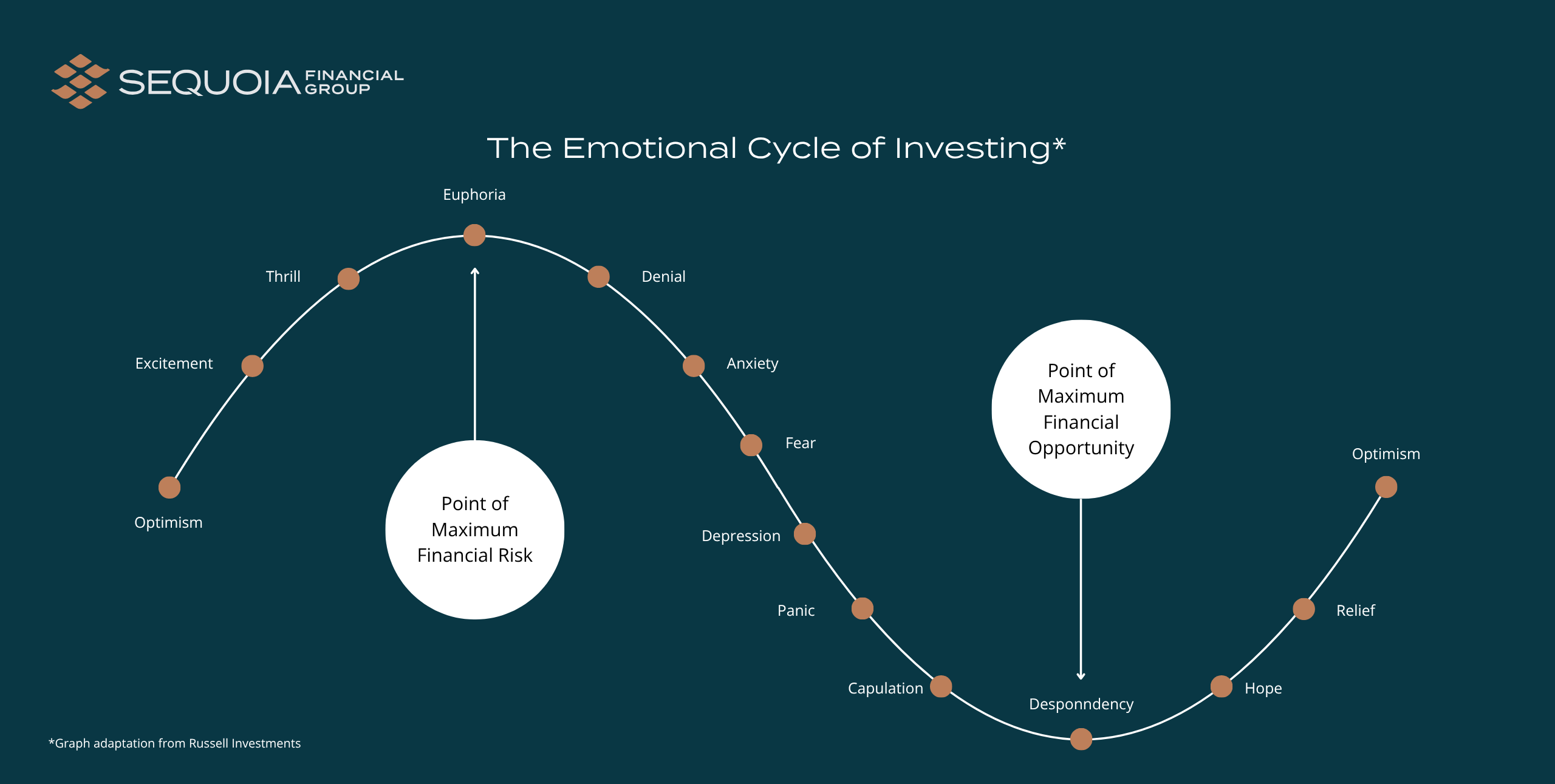
Russell: Cycle of Investor Emotions for Individual | Russell Investments
The above image illustrates a common emotional pattern investors experience as markets rise and fall. Early in a market rally, optimism, excitement, and thrill build as prices climb. At the peak, often characterized by euphoria, risk-taking tends to be highest because confidence is at its highest.
As markets begin to decline, emotions shift quickly from denial to anxiety, fear, and eventually panic or capitulation, the point at which many investors sell after losses have already occurred. Ironically, this moment of increased pessimism is often when long-term opportunity begins to emerge.
Understanding this emotional cycle helps investors recognize that market movements are not just financial events but psychological ones. A disciplined investment strategy, supported by a trusted fiduciary advisor, may help prevent emotional reactions from driving decisions at the worst possible moments.
The Role of a Trusted Fiduciary Partner
At Sequoia Financial Group, we believe financial success is not just about building a sound strategy; it’s about staying true to it.
As a fiduciary, Sequoia is ethically and legally committed to acting in your best interest at all times. That commitment shapes how we advise, plan, and partner with clients, especially during periods of uncertainty, when behavioral biases are most likely to surface.²,⁴
Our role extends beyond portfolio construction. We serve as a stabilizing force when emotions run high, helping clients:
- Re-anchor decisions to long-term goals rather than short-term headlines³
- Understand what market volatility means, and what it doesn’t¹
- Avoid reactive moves that may permanently impair outcomes³
- Maintain perspective during both exuberant markets and difficult ones²
Structure, Accountability, and Clarity, All By Design
Sequoia’s integrated wealth-management approach is intentionally designed to counter behavioral risk. By aligning investment strategy with tax planning, cash-flow needs, risk management, and estate considerations, we create a cohesive plan that supports confident decision-making, even when markets are noisy.
Reviews, proactive communication, and clear frameworks can reinforce disciplined behavior. When volatility rises, clients don’t have to navigate it alone. They have a partner who understands both the numbers and the psychology behind them.
Long-Term Success Is Behavioral Discipline
Markets will always fluctuate. Headlines will always compete for attention. But financial success is rarely determined by reacting faster; it’s determined by staying disciplined.³
With Sequoia Financial Group, clients gain more than an advisor. They gain a fiduciary partner committed to guiding decisions, protecting progress, and keeping long-term goals in focus, no matter what the market is doing today.
Sources:
- Barber, B. M., & Odean, T. (2001). Boys Will Be Boys: Gender, Overconfidence, and Common Stock Investment.
https://faculty.haas.berkeley.edu/odean/papers/gender/BoysWillBeBoys.pdf
BoysWillBeBoys.pdf - CFA Institute – “The Behavioral Biases of Individuals”
https://www.cfainstitute.org/insights/professional-learning/refresher-readings/2026/the-behavioral-biases-of-individuals - Mind Over Markets: How Behavioral Discipline Drives Investment Returns
https://howardcmfunds.com/mind-over-markets-how-behavioral-discipline-drives-investment-returns/ - CFA Institute – Why Behavioral Finance Matters
https://www.cfainstitute.org/insights/articles/behavioral-finance-careers
The views expressed represent the opinion of Sequoia Financial Group. The views are subject to change and are not intended as a forecast or guarantee of future results. This material is for informational purposes only. It does not constitute investment advice and is not intended as an endorsement of any specific investment. Stated information is derived from proprietary and nonproprietary sources that have not been independently verified for accuracy or completeness. While Sequoia believes the information to be accurate and reliable, we do not claim or have responsibility for its completeness, accuracy, or reliability. Statements of future expectations, estimates, projections, and other forward-looking statements are based on available information and Sequoia’s view as of the time of these statements. Accordingly, such statements are inherently speculative as they are based on assumptions that may involve known and unknown risks and uncertainties. Actual results, performance or events may differ materially from those expressed or implied in such statements. Investing in equity securities involves risks, including the potential loss of principal. While equities may offer the potential for greater long-term growth than most debt securities, they generally have higher volatility. Past performance is not an indication of future results. Investment advisory services offered through Sequoia Financial Advisors, LLC, an SEC Registered Investment Advisor. Registration as an investment advisor does not imply a certain level of skill or training.
This material is for informational purposes only and is not intended to serve as a substitute for personalized investment advice or as a recommendation or solicitation of any particular security, strategy, or investment product. Diversification cannot assure profit or guarantee against loss. There is no guarantee that any investment will achieve its objectives, generate positive returns, or avoid losses. Sequoia Financial Advisors, LLC, makes no representations or warranties with respect to the accuracy, reliability, or utility of information obtained from third-parties. Certain assumptions may have been made by these sources in compiling such information, and changes to assumptions may have material impact on the information presented in these materials. Past performance is not an indication of future results. Investment advisory services offered through Sequoia Financial Advisors, LLC, an SEC Registered Investment Advisor. Registration as an investment advisor does not imply a certain level of skill or training.









Hopes of Peace Lift Markets, but Caution Still Warranted