
Market Commentary
U.S. Equities Surge to All-Time Highs as Iran Ceasefire Optimism Takes Hold

by Sequoia Financial Group
by Sequoia Financial Group
U.S. equities surged to all-time highs last week, with the S&P 500 gaining 4.5 percent and the Russell 2000 faring even better, rising 5.6 percent. The Nasdaq Composite climbed 6.8 percent, closing Friday in positive territory for the 13th consecutive session, as risk appetite returned broadly across market cap and style. Bonds also rallied amid a fall in oil prices, which helped ease inflation concerns. The Bloomberg US Aggregate index rose 0.5 percent. The week’s gains erased several weeks of losses and pushed major indices to new record levels, powered by a meaningful shift in sentiment around the U.S.-Iran conflict.
The Iran conflict dominated market sentiment throughout the week. Equities opened lower on Monday after the weekend’s ceasefire talks in Pakistan failed to produce an agreement and the U.S. imposed a naval blockade of the Strait of Hormuz. Markets reversed course as the week progressed, however, buoyed by increasingly constructive rhetoric from the White House and signals that diplomatic channels remained open. Investors appeared to take comfort in the Administration’s stated desire to reach a deal, even as the situation remained fluid. Over the weekend, both sides engaged in pointed posturing: Iran’s Islamic Revolutionary Guard Corps fired on commercial vessels in the Strait and the U.S. seized an Iranian-flagged ship in the Gulf of Oman in the first known use of force under the blockade. The episode laid bare a deepening rift between Iran’s political leadership and its military hard-liners, with Iranian leadership increasingly split between factions willing to negotiate and those opposed to a compromise. United States officials will return to Pakistan for negotiations this week, as the Administration renewed threats on Iranian infrastructure and Iranian state media suggests officials may skip the discussions.
First-quarter earnings season got underway with results from the major U.S. banks, which collectively pointed to a resilient domestic economy despite elevated uncertainty. Revenues and earnings broadly beat expectations, with executives citing continued strength in consumer spending and corporate activity, though several flagged caution around the outlook given the ongoing conflict and its potential impact on energy prices and growth. According to FactSet, consensus expects S&P 500 earnings to grow approximately 13 percent in the first quarter, a constructive backdrop that, if achieved, would help provide fundamental support for equity valuations. With nearly 20 percent of the S&P 500 scheduled to report this week, investors will have ample evidence of how companies fared during the first quarter, though developments out of the Middle East may continue to drive sentiment.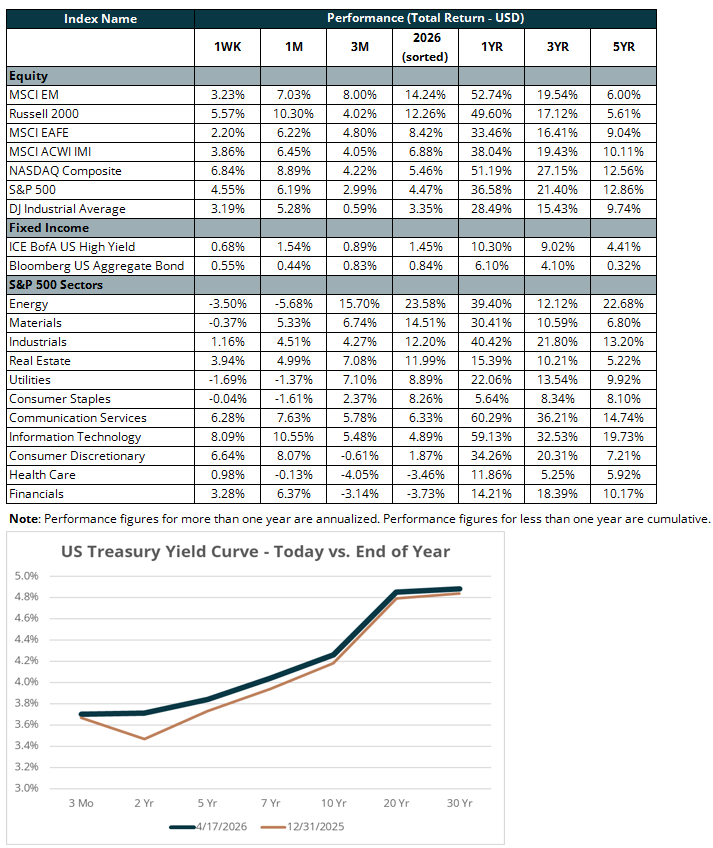
The views expressed represent the opinion of Sequoia Financial Group. The views are subject to change and are not intended as a forecast or guarantee of future results. This material is for informational purposes only. It does not constitute investment advice and is not intended as an endorsement of any specific investment. Stated information is derived from proprietary and nonproprietary sources that have not been independently verified for accuracy or completeness. While Sequoia believes the information to be accurate and reliable, we do not claim or have responsibility for its completeness, accuracy, or reliability. Statements of future expectations, estimates, projections, and other forward-looking statements are based on available information and Sequoia’s view as of the time of these statements. Accordingly, such statements are inherently speculative as they are based on assumptions that may involve known and unknown risks and uncertainties. Actual results, performance or events may differ materially from those expressed or implied in such statements. Investing in equity securities involves risks, including the potential loss of principal. While equities may offer the potential for greater long-term growth than most debt securities, they generally have higher volatility. Past performance is not an indication of future results. Investment advisory services offered through Sequoia Financial Advisors, LLC, an SEC Registered Investment Advisor. Registration as an investment advisor does not imply a certain level of skill or training.









Tech Stocks Carry NASDAQ to Record High