
Market Commentary
Rising Oil Prices, Inflation Expectations Send Stocks and Bonds to 2026 Lows

by Sequoia Financial Group
by Sequoia Financial Group
The Iran conflict showed no signs of letting up last week, as Israel bombed Iran’s giant South Pars gas field and Iran struck Qatar’s important Ras Laffan LNG hub. The attack on South Pars was seen as an escalation, as the field serves as an energy lifeline for Iran. Meanwhile, the retaliatory strike on Ras Laffan knocked out 17 per cent of Qatar’s LNG capacity for up to five years and will cost the country an estimated $20 billion/year in energy revenue. The continued fighting pushed oil prices over $100/barrel and gas prices to near $4/gallon, both of which will weigh on economic growth in the US and globally.
Higher energy prices also feed inflation. Indeed, the Federal Reserve has increased its inflation expectation to 2.7 per cent from 2.4 per cent, well above the Fed’s two per cent target. Stubbornly high inflation pushed the Fed to hold interest rates at current levels for the second meeting in a row. Chairman Powell said a high level of uncertainty still surrounds the impact of the Iran conflict on the economy, but the Fed still expects to cut rates at some point in 2026. The financial markets aren’t betting on it. CME’s FedWatch, which calculates the likelihood of rate changes based on the actions of interest-rate traders, shows just a seven per cent chance of a rate cut this year and a nearly 30 per cent chance of a rate increase. Prior to the Iran war, odds of a rate cut topped 90 per cent and odds of a rate hike were zero.
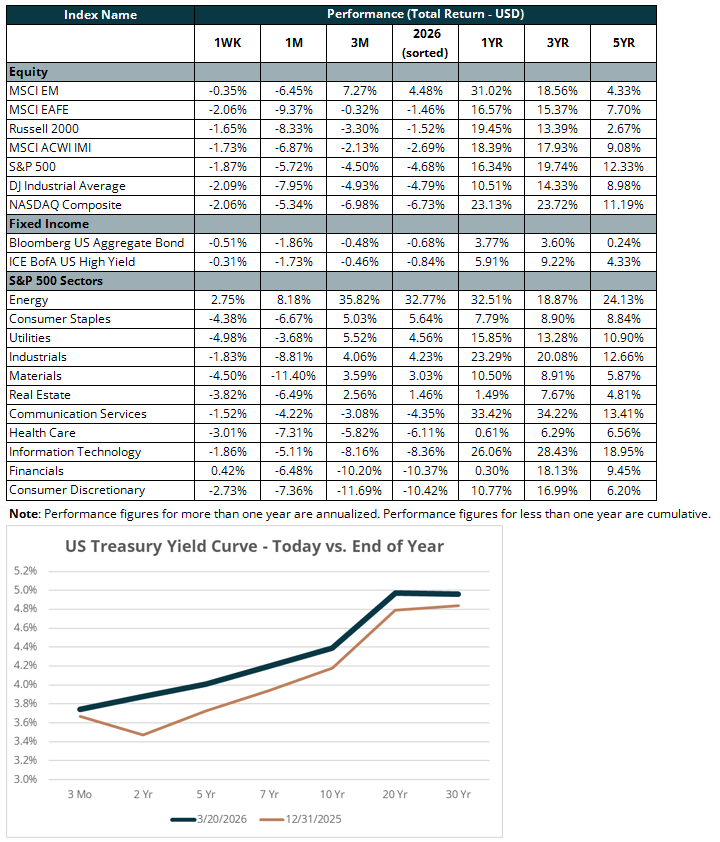
Against that backdrop, stocks and bonds have slumped. The S&P 500 lost ground for the fourth week in a row and the Bloomberg Aggregate Bond Index (“Agg”) dipped for the third week in a row. Energy stocks and defense stocks remain the two bright spots. Exxon and Chevron both reached all-time highs last week, rallying more than 30 per cent since the first of the year. In the defense sector, Lockheed Martin and Northrop Grumman have both jumped more than 25 per cent. On the bond side, the Agg has dropped 1.5 per cent over the last month and like the three US stock market indices sits in the red for the year to date.
The S&P 500 dropped 4.3 per cent in the first quarter of 2025 and is facing a similar first-quarter loss in 2026. Markets rebounded sharply off the tariff crisis in 2025 and there’s hope for a similar rebound in 2026 once the Iran situation is resolved. Until then, markets will remain focused on the price of oil and the Persian Gulf.
The views expressed represent the opinion of Sequoia Financial Group. The views are subject to change and are not intended as a forecast or guarantee of future results. This material is for informational purposes only. It does not constitute investment advice and is not intended as an endorsement of any specific investment. Stated information is derived from proprietary and nonproprietary sources that have not been independently verified for accuracy or completeness. While Sequoia believes the information to be accurate and reliable, we do not claim or have responsibility for its completeness, accuracy, or reliability. Statements of future expectations, estimates, projections, and other forward-looking statements are based on available information and Sequoia’s view as of the time of these statements. Accordingly, such statements are inherently speculative as they are based on assumptions that may involve known and unknown risks and uncertainties. Actual results, performance or events may differ materially from those expressed or implied in such statements. Investing in equity securities involves risks, including the potential loss of principal. While equities may offer the potential for greater long-term growth than most debt securities, they generally have higher volatility. Past performance is not an indication of future results. Investment advisory services offered through Sequoia Financial Advisors, LLC, an SEC Registered Investment Advisor. Registration as an investment advisor does not imply a certain level of skill or training.









Financial Markets Still Grappling with High Oil Prices and Higher Interest Rates