
Market Commentary
Iran Stalks Strait of Hormuz Chokepoint, Stoking Inflation Concerns

by Sequoia Financial Group
by Sequoia Financial Group
The Iran War intensified last week, as Iranian attacks on commercial ships in effect closed the Strait of Hormuz. The Trump administration tried to downplay the significance of the war’s impact via a now-deleted X post from Secretary of Energy Chris Wright, which initially claimed that US warships successfully escorted an oil tanker through the waterway. That claim later turned out to be false. On the contrary, US Navy officials refer to the Strait as a “kill box” for American ships vulnerable to Iranian drones and antiship missiles. The President ended the week asking other countries for help in re-opening the Strait of Hormuz. There was little response to the plea, even from Asian nations that heavily depend on exports passing through the waterway.
To ease supply constraints, the International Energy Agency announced a total of 400 million barrels of oil would be released from its 32 member countries’ strategic reserves. That announcement wasn’t enough to bring down oil prices, however. Spot prices (immediate delivery) for Brent crude oil ended the week at $104/bbl, up from $87 last week. The significant lead time for oil reserves to get to market means it will take about four months to get the US’ share of strategic reserves (172 million barrels) to come online. Our Strategic Petroleum Reserve facilities – salt caverns in Louisiana and Texas – can’t be tapped quickly. Even with shorter lead times, markets might doubt that reserves can offset a Strait of Hormuz disruption, given that roughly 20 percent of the world’s 100 million bbls/day oil supply flows through it.
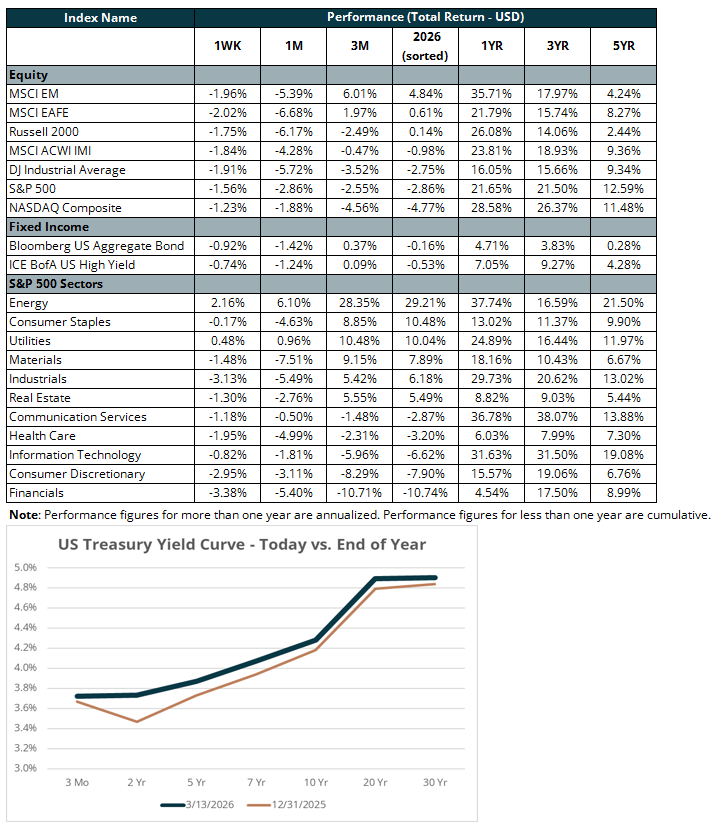
Equities finished lower last week. The S&P 500, an index of large US companies, was down 1.5 percent for the week and has returned -2.9 percent year to date (YTD). The only S&P sectors that generated positive returns last week were Energy and Utilities – the former benefiting from higher oil prices and the latter from the market’s defensive posturing.
Bonds were unable to buffer equity declines, as rates ended the week higher. The bond markets were more concerned with the upside risks to inflation than the downside risks to economic growth. Indeed, financial markets do not expect the Fed to cut rates at its meeting this week. The Bloomberg US Aggregate Bond Index fell 0.9 percent last week and is relatively flat YTD.
All eyes will be on developments in Iran this week. Further sell-offs in the financial markets may incentivize the US to strike a ceasefire deal with Iran. On Saturday, the President stated Iran was ready to negotiate a deal – a claim denied by Iran’s Foreign Minister.
The views expressed represent the opinion of Sequoia Financial Group. The views are subject to change and are not intended as a forecast or guarantee of future results. This material is for informational purposes only. It does not constitute investment advice and is not intended as an endorsement of any specific investment. Stated information is derived from proprietary and nonproprietary sources that have not been independently verified for accuracy or completeness. While Sequoia believes the information to be accurate and reliable, we do not claim or have responsibility for its completeness, accuracy, or reliability. Statements of future expectations, estimates, projections, and other forward-looking statements are based on available information and Sequoia’s view as of the time of these statements. Accordingly, such statements are inherently speculative as they are based on assumptions that may involve known and unknown risks and uncertainties. Actual results, performance or events may differ materially from those expressed or implied in such statements. Investing in equity securities involves risks, including the potential loss of principal. While equities may offer the potential for greater long-term growth than most debt securities, they generally have higher volatility. Past performance is not an indication of future results. Investment advisory services offered through Sequoia Financial Advisors, LLC, an SEC Registered Investment Advisor. Registration as an investment advisor does not imply a certain level of skill or training.









Equities Extend Losing Streak as Iran Conflict Roils Markets