
Market Commentary
AI Funding Fears Push Investors Toward Defensive Positioning

by Sequoia Financial Group
by Sequoia Financial Group
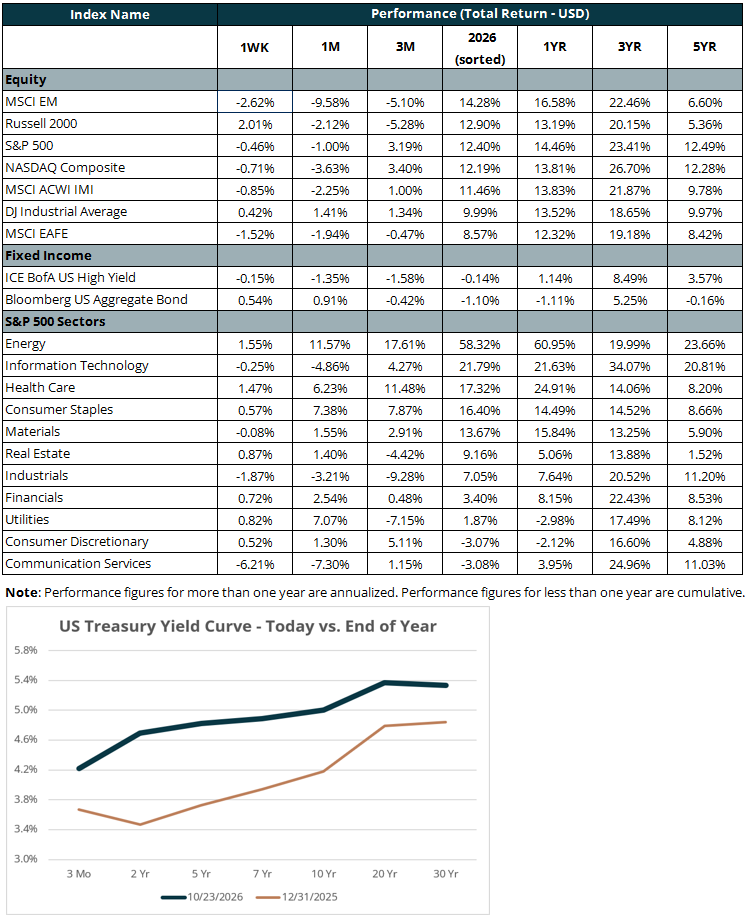
The S&P 500 finished the week lower as the market turned Meta Platforms’ (ticker: META) strong earnings report into concerns about the cost of artificial intelligence. The company posted record third-quarter revenue, but investors focused more on the report’s read-throughs. Free cash flow (i.e., cash profits minus capital expenditures) turned negative for the first time since Meta went public. Spending commitments rose to roughly $825 billion from about $700 billion in July. Shares fell 7.0 percent Thursday and 9.0 percent for the week. META’s selloff trickled through the rest of the growth-oriented equities. The Nasdaq Composite index declined 2.6 percent on Thursday and 0.7 percent for the week.
Thursday’s selloff related to the financing of AI rather than the technology’s advancements. Meta’s filing said capital raises by Alphabet and SpaceX, plus expected fundraising by Anthropic and OpenAI, have crowded the market for capital. Meta plans to move before rivals tie up what is left. Scrutiny of Anthropic’s draft IPO filing shows the scale of that appetite. The AI developer booked $16.3 billion in first half revenue against roughly $450 billion in cloud computing commitments over the next seven to ten years. Volatility was the market’s reaction to how the related commitments could be funded Fall at once.
Not all parts of the equity market sold off, however. The S&P 500 fell 1.2 percent Thursday, yet its equal-weight counterpart (ticker: RSP) gained 0.7 percent. Growth lost 2.7 percent while value rose 0.3 percent in the Russell 3000. Consumer staples (ticker: XLP) rose 3.3 percent, utilities (ticker: XLU) 2.1 percent, and healthcare (ticker: XLV) 1.3 percent. Healthcare’s climb has turned a 25 percent valuation discount to the S&P 500 a year ago into a slight premium. A Goldman Sachs analyst indicated that this may be a warning of fading confidence in earnings elsewhere. In a parallel drawn by The Wall Street Journal to the period immediately before the 2007-08 global financial crisis, the S&P 500’s forward multiple compressed from about 18 to 15 while healthcare kept its premium. A 0.5 percent Friday rebound in technology (ticker: XLK) could not pull the S&P 500 out of the red.
Bonds offered ballast. The iShares Core US Aggregate Bond ETF (ticker: AGG) gained 0.9 percent Thursday and 0.6 percent for the week. The 10-year Treasury yield fell nearly 0.2 percentage points that day to below 5 percent, its largest one-day decline since March 2023. Slower tech spending could cool growth and inflation, easing pressure on the Fed to raise rates. Oil offered no relief against further rate hikes, however. December Brent crude futures topped $114 a barrel Friday as Iran warned of wider retaliation if strikes resume.
Next week puts the funding question to the biggest spenders. Amazon (ticker: AMZN), Alphabet (ticker: GOOGL), and Microsoft (ticker: MSFT) report earnings, and investors will want to know how their capex will be funded. Eli Lilly (ticker: LLY), the largest healthcare stock in the S&P 500, will test the healthcare trade. The Fed meets Wednesday, with GDP, PCE inflation, and jobless claims Thursday, and the Employment Cost Index Friday. A softer inflation read would support the bond rally that cushioned portfolios this week.
The views expressed represent the opinion of Sequoia Financial Group. The views are subject to change and are not intended as a forecast or guarantee of future results. This material is for informational purposes only. It does not constitute investment advice and is not intended as an endorsement of any specific investment. Stated information is derived from proprietary and nonproprietary sources that have not been independently verified for accuracy or completeness. While Sequoia believes the information to be accurate and reliable, we do not claim or have responsibility for its completeness, accuracy, or reliability. Statements of future expectations, estimates, projections, and other forward-looking statements are based on available information and Sequoia’s view as of the time of these statements. Accordingly, such statements are inherently speculative as they are based on assumptions that may involve known and unknown risks and uncertainties. Actual results, performance or events may differ materially from those expressed or implied in such statements. Investing in equity securities involves risks, including the potential loss of principal. While equities may offer the potential for greater long-term growth than most debt securities, they generally have higher volatility. Past performance is not an indication of future results. Investment advisory services offered through Sequoia Financial Advisors, LLC, an SEC Registered Investment Advisor. Registration as an investment advisor does not imply a certain level of skill or training.









AI Funding Fears Push Investors Toward Defensive Positioning