
Insights
Donor-Advised Funds vs. Private Foundations: Which Is Right for Your Legacy?

by Sequoia Financial Group
by Sequoia Financial Group
Charitable giving may be about more than supporting the causes you care about today. It can also be an opportunity to establish a lasting legacy, engage future generations, and align your wealth with your values.
For individuals and families considering a more structured approach to philanthropy, two common options are donor-advised funds (DAFs) and private foundations. Both can support long-term charitable goals, but they differ in control, flexibility, cost, and administrative responsibilities.
Understanding these differences can help you determine which approach best supports your broader financial and legacy planning objectives.
What Is a Donor-Advised Fund?
A donor-advised fund is a charitable giving account established through a sponsoring nonprofit organization. Donors contribute assets, potentially receive an immediate charitable tax deduction, and recommend grants to eligible charities over time.
The sponsoring organization maintains legal control of the assets, while donors retain advisory privileges regarding investments and distributions.¹
Potential advantages include:
- Simplified administration and generally lower operating costs.
- Flexibility to recommend charitable grants over time.
- Opportunities to involve family members in giving decisions.
- Potential tax benefits when contributing appreciated assets.
For donors seeking a streamlined way to organize their philanthropy without managing a separate charitable entity, a DAF may be an attractive option.
What Is a Private Foundation?
A private foundation is an independent charitable organization, often established and funded by an individual or family.
Unlike a DAF, a private foundation can provide greater authority over charitable strategy, investment management, governance, and grantmaking. This flexibility comes with additional responsibilities.
Most private nonoperating foundations must satisfy annual charitable distribution requirements generally based on approximately 5% of their investment assets. They are also subject to reporting obligations and restrictions on transactions involving certain insiders.²,³
Potential advantages include:
- Greater control over charitable priorities and grantmaking.
- A formal structure for multigenerational family involvement.
- Flexibility to pursue certain charitable initiatives beyond traditional grants.
- Opportunities to establish a distinct family philanthropic identity.
Private foundations may appeal to families seeking a more hands-on approach to philanthropy and willing to manage the associated administrative and regulatory obligations.
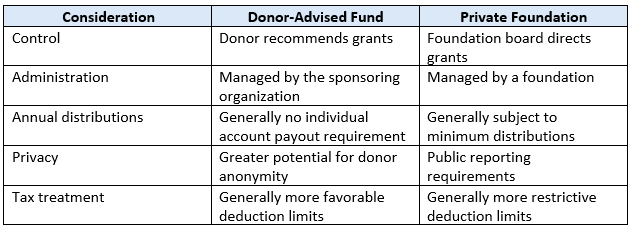
Which Charitable Giving Strategy Fits Your Goals?
The decision may comes down to how involved you want to be and the level of funding you intend to commit to your philanthropic goals.
A DAF may be appropriate if simplicity, flexibility, and administrative efficiency are priorities. A private foundation may be worth considering if your goals include direct oversight, formal family governance, or a more expansive philanthropic mission. However, the costs and administrative complexities associated with establishing and maintaining a private foundation generally make it more practical for families planning to commit substantial charitable assets.
For some families, using both structures may provide complementary benefits.
Building a Charitable Legacy That’s BUILT FOR YOU
Your charitable strategy can reflect more than your generosity. It could complement your tax planning, estate strategy, family priorities, and long-term financial goals.
At Sequoia Financial Group, our BUILT FOR YOU approach considers how charitable giving fits within your broader wealth management strategy, helping you make thoughtful decisions about the impact you want your wealth to have today and for generations to come.
Sources
- IRS — Donor-Advised Funds https://www.irs.gov/charities-non-profits/charitable-organizations/donor-advised-funds
- IRS — Private Foundations: Minimum Distribution Requirements https://www.irs.gov/statistics/soi-tax-stats-private-foundations-study-terms-and-concepts
- IRS — Private Foundations: Reporting and Regulatory Requirements https://www.irs.gov/charities-non-profits/charitable-organizations/private-foundations
- IRS — Charitable Contribution Deductions https://www.irs.gov/charities-non-profits/charitable-organizations/charitable-contribution-deductions
- IRS — Public Disclosure Requirements for Private Foundations https://www.irs.gov/charities-non-profits/public-disclosure-and-availability-of-exempt-organizations-returns-and-applications-requirements-for-private-foundations
The views expressed represent the opinion of Sequoia Financial Group. The views are subject to change and are not intended as a forecast or guarantee of future results. This material is for informational purposes only. It does not constitute investment advice and is not intended as an endorsement of any specific investment. Stated information is derived from proprietary and nonproprietary sources that have not been independently verified for accuracy or completeness. While Sequoia believes the information to be accurate and reliable, we do not claim or have responsibility for its completeness, accuracy, or reliability. Statements of future expectations, estimates, projections, and other forward-looking statements are based on available information and Sequoia’s view as of the time of these statements. Accordingly, such statements are inherently speculative as they are based on assumptions that may involve known and unknown risks and uncertainties. Actual results, performance or events may differ materially from those expressed or implied in such statements. Investing in equity securities involves risks, including the potential loss of principal. While equities may offer the potential for greater long-term growth than most debt securities, they generally have higher volatility. Past performance is not an indication of future results. Investment advisory services offered through Sequoia Financial Advisors, LLC, an SEC Registered Investment Advisor. Registration as an investment advisor does not imply a certain level of skill or training.
This material is for informational purposes only and is not intended to serve as a substitute for personalized investment advice or as a recommendation or solicitation of any particular security, strategy, or investment product. Diversification cannot assure profit or guarantee against loss. There is no guarantee that any investment will achieve its objectives, generate positive returns, or avoid losses. Sequoia Financial Advisors, LLC makes no representations or warranties with respect to the accuracy, reliability, or utility of information obtained from third parties. Certain assumptions may have been made by these sources in compiling such information, and changes to assumptions may have material impact on the information presented in these materials.
Investment advisory services offered by Sequoia Financial Advisors, LLC, an SEC Registered Investment Advisor. Registration as an investment advisor does not imply a certain level of skill or training.









Renewed AI Capex Concerns Spark Rotation Out of Tech