
Wealth Planning
What High-Net-Worth Investors Should Know About the 4-Year Presidential Market Cycle

by Sequoia Financial Group
by Sequoia Financial Group
Every market cycle may feel different while you’re living through it. Headlines change, investor sentiment shifts, and uncertainty may often dominate the conversation. Yet history reminds us that markets tend to follow recognizable patterns over time, even when the reasons behind them vary.
One of the most closely watched patterns is the four-year election cycle. While no historical trend guarantees future results, decades of market data show that volatility and investor behavior often follow a familiar rhythm around national election cycles. Understanding that rhythm can help investors remain disciplined rather than reactive.
The Four-Year Presidential Cycle in Perspective
Historically, the second year of the four-year presidential election cycle has tended to experience higher volatility than the other three years. Policy uncertainty, changing economic expectations, and shifting investor sentiment often contribute to larger market swings during this period.¹
By contrast, the third year has historically produced some of the strongest average equity returns in the cycle as uncertainty begins to ease and markets increasingly focus on corporate earnings, economic growth, and longer-term fundamentals rather than political headlines.²
Importantly, these are historical tendencies, not investment rules. Every cycle is influenced by its own mix of inflation, interest rates, corporate earnings, global events, and economic conditions.
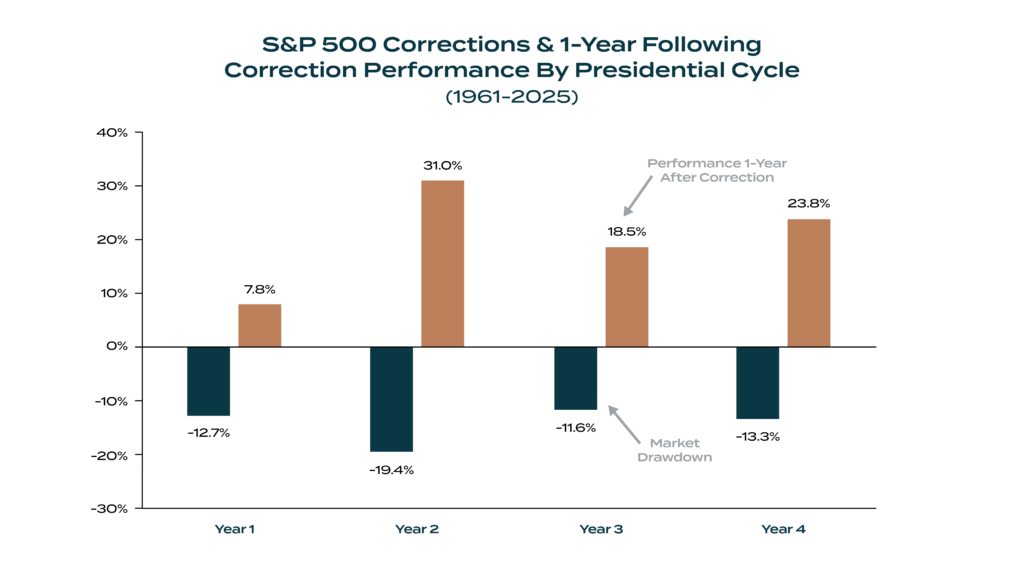
While every market cycle is different, historical data illustrates why maintaining a long-term perspective matters. Since 1961, the second year of the presidential cycle has experienced the deepest average market correction, but it has also been followed by the strongest average one-year recovery. Rather than viewing periods of heightened volatility as reasons to abandon a disciplined investment strategy, history suggests they have often preceded meaningful market rebounds.
Headlines Are Temporary. Planning Shouldn’t Be.
One of the greatest risks for high-net-worth investors is allowing short-term uncertainty to drive long-term decisions.
Periods of elevated volatility may often tempt investors to reduce risk after markets have already declined or chase opportunities after markets have already recovered. Research consistently shows that attempting to time these shifts is difficult and may significantly reduce long-term investment results.³
For investors managing substantial wealth, these decisions may become even more consequential. Large taxable portfolios, concentrated positions, business interests, trusts, charitable strategies, and multigenerational planning all introduce layers of complexity that extend well beyond market performance.
A Better Way to Navigate Cycles
Rather than attempting to predict every market move, successful investors may typically focus on controlling what they can:
- Maintaining an investment strategy aligned with long-term objectives.
- Rebalancing portfolios when appropriate.
- Managing taxes alongside investment decisions.
- Preserving adequate liquidity.
- Reviewing risk as personal circumstances evolve.
These planning decisions can have a greater impact on long-term outcomes than reacting to the latest market narrative.
Built for the Long Term
At Sequoia Financial Group, we believe portfolios should be BUILT FOR YOU; designed around your life, goals, and values rather than the current stage of the market cycle.
Our integrated approach combines investment management with tax planning, estate planning, risk management, and cash flow strategy to help ensure every financial decision supports your broader objectives. When markets inevitably become noisy, having a comprehensive plan can provide clarity and confidence.
Market cycles will continue. Headlines will change. The investors most likely to achieve lasting success are often those who remain focused on their long-term plan rather than the next news cycle.
Sources:
- J.P. Morgan Asset Management. Guide to the Markets – U.S. https://am.jpmorgan.com/us/en/asset-management/adv/insights/market-themes/us-elections/
- CFA Institute. Presidential Election Cycle Theory: A Bullish Perspective. https://rpc.cfainstitute.org/comment/reply/node/129226/field_comments
- J.P Morgan. Avoiding the Cash Trap. https://am.jpmorgan.com/us/en/asset-management/adv/insights/market-themes/cash/
The views expressed represent the opinion of Sequoia Financial Group. The views are subject to change and are not intended as a forecast or guarantee of future results. This material is for informational purposes only. It does not constitute investment advice and is not intended as an endorsement of any specific investment. Stated information is derived from proprietary and nonproprietary sources that have not been independently verified for accuracy or completeness. While Sequoia believes the information to be accurate and reliable, we do not claim or have responsibility for its completeness, accuracy, or reliability. Statements of future expectations, estimates, projections, and other forward-looking statements are based on available information and Sequoia’s view as of the time of these statements. Accordingly, such statements are inherently speculative, as they are based on assumptions that may involve known and unknown risks and uncertainties. Actual results, performance, or events may differ materially from those expressed or implied in such statements. Investing in equity securities involves risks, including the potential loss of principal. While equities may offer the potential for greater long-term growth than most debt securities, they generally have higher volatility. Past performance is not an indication of future results.
Investment advisory services offered by Sequoia Financial Advisors, LLC, an SEC Registered Investment Advisor. Registration as an investment advisor does not imply a certain level of skill or training.









Can AI Strength Continue to Offset Deteriorating Market Breadth?