
Market Commentary
AI Trade Rebounds Despite Nvidia Losing Its CEO

by Sequoia Financial Group
by Sequoia Financial Group
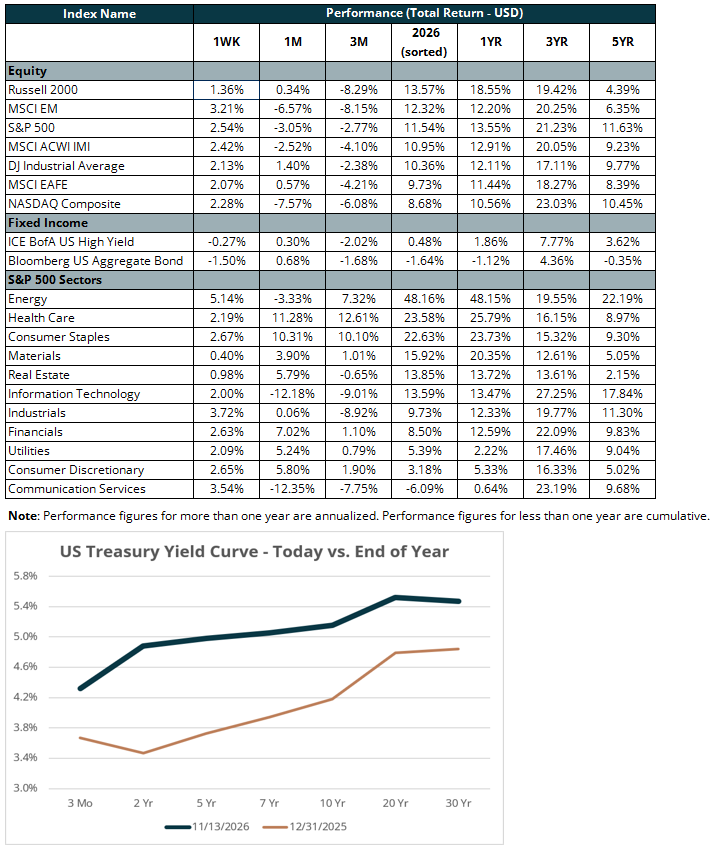
US equities rose this week, shrugging off a hot inflation report, hawkish Fed commentary, and a leadership crisis at Nvidia (ticker: NVDA). The S&P 500 rose 2.6%, the Dow Jones Industrial Average gained 2.1%, and the Nasdaq Composite added 2.3%. Every sector finished higher, and the equal-weight S&P 500 (ticker: RSP) rose 2.4%, roughly in line with its cap-weighted counterpart. Monday delivered a good session for the S&P 500, its strongest since March. Aggressive deleveraging in October had left positioning cleaner, and seasonal trends turned supportive. AI and momentum stocks led the rebound.
Nvidia was the glaring exception. Over the weekend, CEO Jensen Huang admitted to an affair with an executive at a Singapore data-center firm whom US officials suspect of spying for China. On Thursday, Nvidia confirmed Huang had resigned following two extramarital affairs, the second involving a company employee. Chief Financial Officer Colette Kress has been named interim CEO, and longtime director Harvey Jones became the board’s first-ever chair. The company shed more than $600 billion in market value this week. The broader AI trade did not follow it down. The PHLX Semiconductor Index gained 8.1%, and the Roundhill Memory ETF (ticker: DRAM) climbed 7.9%. Rivals Broadcom (ticker: AVGO) and Advanced Micro Devices (ticker: AMD) also gained.
The larger question may be whether Nvidia’s role in financing AI demand survives the transition. Under Huang, Nvidia extended credit support to chip buyers. Kress has previously questioned parts of that strategy. According to The Wall Street Journal, she pressed on how the guarantees were valued and cut Nvidia’s commitment to an OpenAI data-center project in half this summer. A more cautious Nvidia could mean less capital flowing into AI infrastructure.
Rising yields tempered gains later in the week. On Tuesday, October core CPI topped forecasts, led by medical care, auto insurance, and a record monthly jump in smartphone prices. The two-year Treasury yield posted its biggest single day rise since October 2024. Fed Governor Christopher Waller had argued a hot print would warrant a 50-basis-point hike. Yields climbed across the curve in their strongest week since April 2025. The 10-year Treasury yield rose 28 basis points, and the Bloomberg US Aggregate Bond Index fell 1.5%. The dollar index gained 1.1% to near a 19-month high. Gold (ticker: GLD) fell 4.6%.
Underlying AI demand still looks firm. CoreWeave (ticker: CRWV) posted strong results on Wednesday, and its CEO reaffirmed robust demand for AI computing capacity. Next week may test whether investors keep funding it. Anthropic (ticker: ANT) plans to begin trading on the Nasdaq next Thursday. The company is seeking a valuation of roughly $1.3 trillion, below the $1.5 trillion investors expected a week earlier. Its annualized revenue run rate reached about $81 billion as of October. A strong debut would signal that capital may still be available for the AI buildout. A tepid one would add to the concern that the industry’s funding pipeline may be tightening.
The views expressed represent the opinion of Sequoia Financial Group. The views are subject to change and are not intended as a forecast or guarantee of future results. This material is for informational purposes only. It does not constitute investment advice and is not intended as an endorsement of any specific investment. Stated information is derived from proprietary and nonproprietary sources that have not been independently verified for accuracy or completeness. While Sequoia believes the information to be accurate and reliable, we do not claim or have responsibility for its completeness, accuracy, or reliability. Statements of future expectations, estimates, projections, and other forward-looking statements are based on available information and Sequoia’s view as of the time of these statements. Accordingly, such statements are inherently speculative as they are based on assumptions that may involve known and unknown risks and uncertainties. Actual results, performance or events may differ materially from those expressed or implied in such statements. Investing in equity securities involves risks, including the potential loss of principal. While equities may offer the potential for greater long-term growth than most debt securities, they generally have higher volatility. Past performance is not an indication of future results. Investment advisory services offered through Sequoia Financial Advisors, LLC, an SEC Registered Investment Advisor. Registration as an investment advisor does not imply a certain level of skill or training.









AI Trade Rebounds Despite Nvidia Losing Its CEO