
Insights
Q3 Market Recap: Climbing the Wall of Worry

by Sequoia Financial Group
by Sequoia Financial Group
Investors spend a great deal of energy trying to figure out what will happen next. In our experience, it is often more productive to ask a different question: What is already reflected in prices, and how might we be wrong?
The third quarter gave us plenty to think about. Oil held above $100 per barrel for much of the period as conflict in the Middle East persisted. The Federal Reserve raised rates in September for the first time since 2023. And investors began, for the first time in this cycle, to seriously question the pace and durability of AI-related investment, which has been a major contributor to both economic growth and corporate profits.
Any one of these would have been a reasonable excuse for markets to stumble. Instead, global equities ended the quarter near all-time highs. Perhaps more notable, valuations became more reasonable over the course of the year, not because prices fell, but because earnings rose faster than prices did.
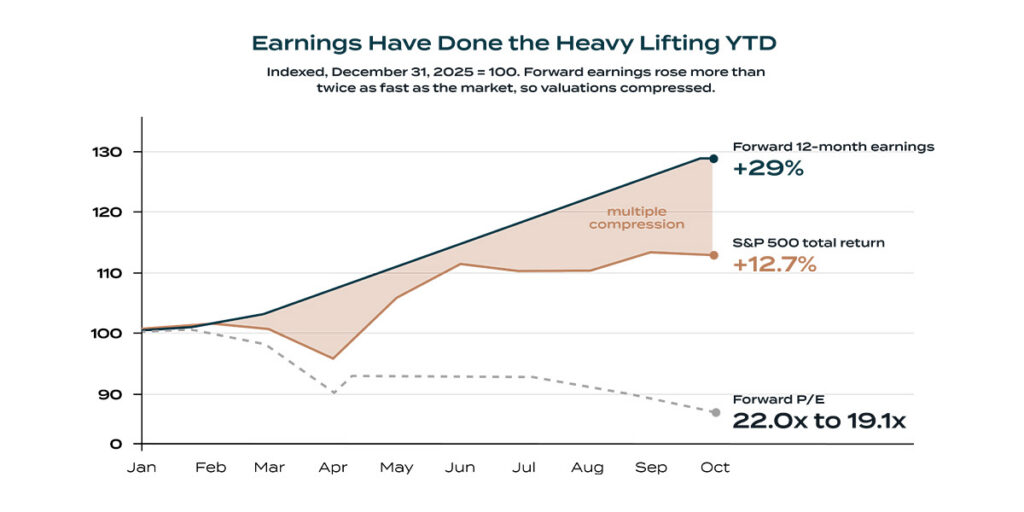 That is a constructive state of affairs. But a constructive environment is not the same as a riskless one, and the moments when things feel most comfortable are often the ones that call for the most care. Our summary view: The backdrop remains supportive, but it is less forgiving of complacency than it was.
ENERGY: FROM DISRUPTION TO A HIGHER COST BASE
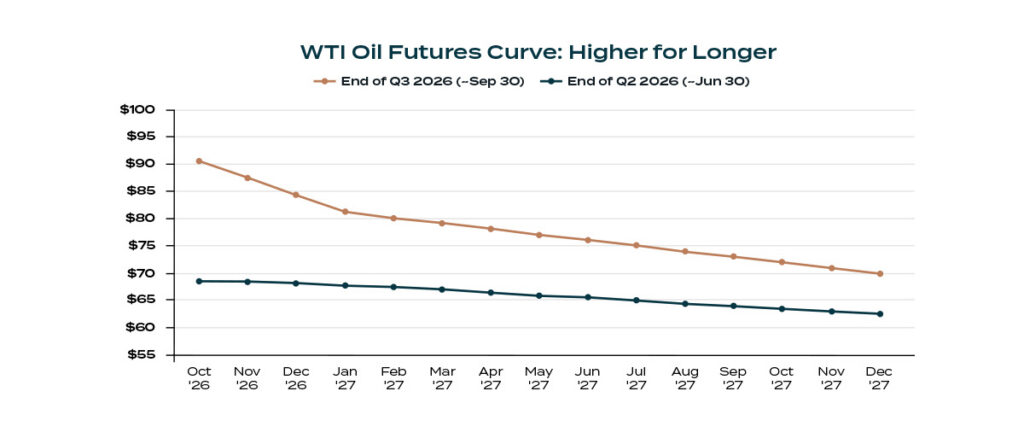
Oil has been in focus all year, but the market’s view of it changed this quarter in a way that deserves attention. In early summer, the futures curve implied prices drifting back toward the $70s by early next year. Today, the entire curve has moved higher. A spike in the front month is a tax on one quarter; a shift in the whole curve is a change in the assumed cost of energy for years. Investors have gone from treating the conflict as a temporary disruption to treating it as a possible change in level.
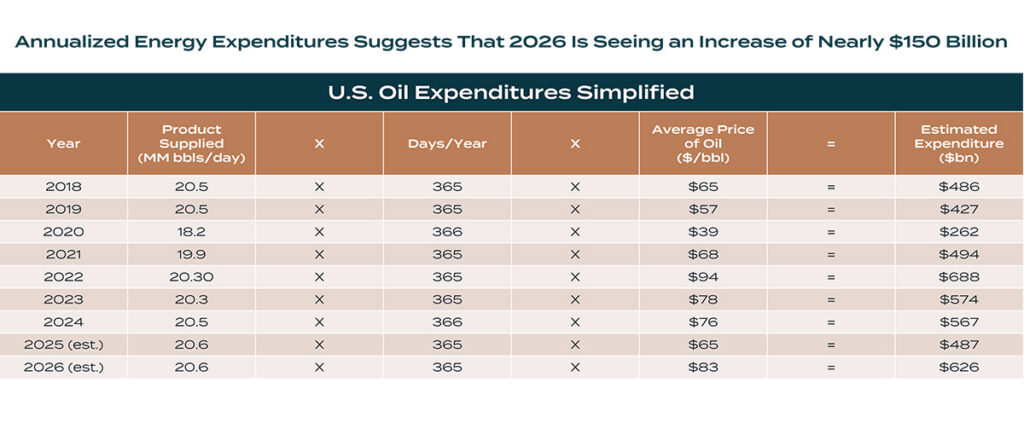
 The burden is real. Annualized energy spending is on track to rise by nearly $150 billion in 2026, and gasoline reached roughly $4.50 per gallon this summer, about 43% above a year earlier. That money comes out of other spending, and it falls hardest on lower- and middle-income households.
Energy also feeds directly into the inflation data the Fed watches. Headline CPI began the year near 2.4%, rose above 4% in the spring, and has since eased to the mid-3% range. What concerns us more than the level is the persistence. Supply-driven price pressures have lasted long enough to begin working into the slower-moving parts of inflation, such as contracts, wages, and expectations, where they tend to linger. Higher interest rates can cool demand, but they cannot reopen a shipping lane.
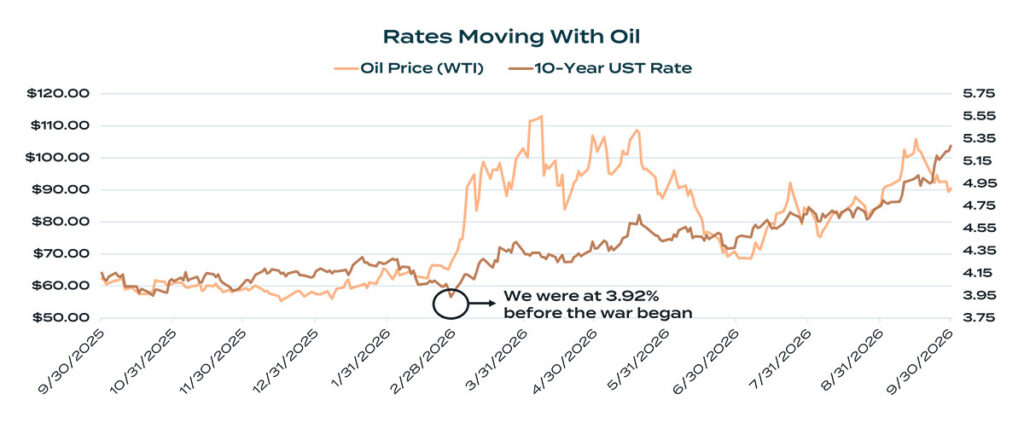
A note of humility belongs here. Oil’s path is genuinely unknowable. Prices could fall quickly if tensions ease or rise sharply if disruptions broaden. What we can observe is how sensitive markets have become: even modest, good news on energy has been enough to pull interest rates meaningfully lower. A durable resolution would be among the most constructive outcomes for the global economy, but it is not something we would assume when building a portfolio.
THE FED CHANGES DIRECTION
On September 16, the Federal Reserve unanimously raised the federal funds target range by 25 basis points to 3.75%–4.00%, reversing one of last year’s three cuts. Chair Warsh described the move as removing a dose of accommodation. The outcome was far from assured: Market odds of a hike swung from above 70% in July to near 40% in August and back to roughly even, before Warsh’s hawkish Jackson Hole remarks helped settle the matter.
We take three messages from the decision: The Fed is willing to act independently on its own reading of the economy; it is intent on rebuilding its inflation-fighting credibility; and it believes the economy is sturdy enough to absorb tighter conditions. The Committee’s projections point to a higher-for-longer path, which means a higher floor on cash yields and a longer wait for rate relief.
There is an important limitation, though. Much of today’s inflation is coming from energy rather than from an overheating economy. A rate hike can defend credibility against a supply shock, but it cannot cure one. The encouraging offset is that market-based inflation expectations remain well anchored; investors are treating the energy spike as temporary rather than as a new regime. That is what gives the Fed room to move once and wait. If expectations were to break higher, the path would likely steepen.
Looking past this cycle, Chair Warsh is reshaping the institution itself through five task forces covering communications, the balance sheet, data quality, AI-driven productivity, and the Fed’s inflation framework. For investors, the practical result is a less predictable Fed, with fewer forward-guidance commitments and, likely, more volatility around policy decisions. This is a multi-year story, not a quarterly one.
INTEREST RATES AND THE FISCAL BACKDROP
Long-term rates have been the common thread running through this year’s markets, and it helps to separate the structural from the immediate. The structural story is fiscal: Large, persistent deficits require governments to keep borrowing regardless of where rates are, and investors are demanding more compensation to lend for longer. The immediate catalyst has been energy and the inflationary impulse of war. The 10-year Treasury yield stood at 3.92% just before the Iran conflict began; it ended Q3 at 5.3%. In fact, in the third quarter the 10-year rose about 85 basis points. That is the largest quarterly increase since the first quarter of 1994.
That said, the U.S. arithmetic is sobering. Under Congressional Budget Office projections, the total deficit grows from 5.8% of GDP in 2026 to 6.7% by 2036, yet the primary deficit, which is spending before interest, actually declines. The entire deterioration comes from interest costs, which rise from 3.3% to 4.6% of GDP. The government is increasingly borrowing to pay for past borrowing, and because those projections assume rates below where markets trade today, they are likely too optimistic.
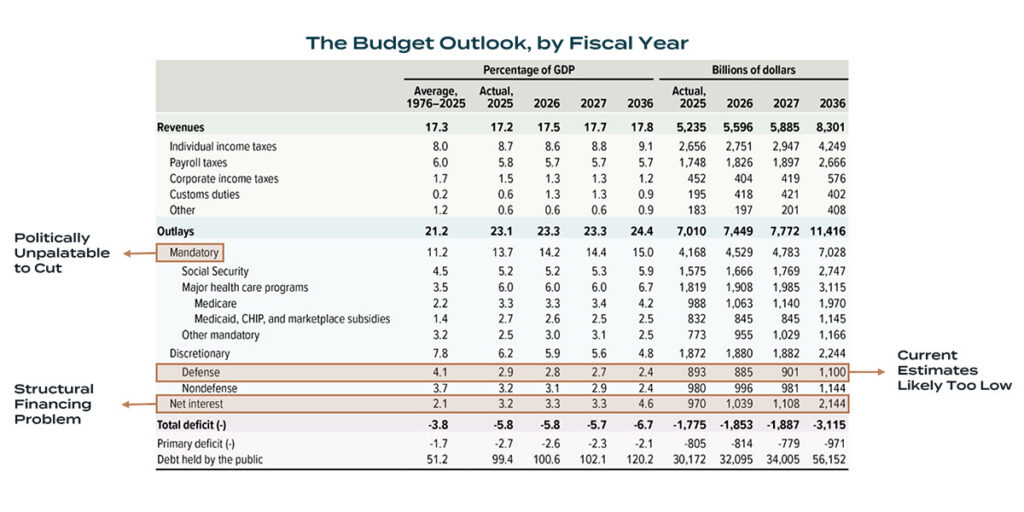
Policymakers have tried to lean against this. Over the summer the Treasury doubled its buybacks of long-dated bonds, funded with short-term bills, in a move reminiscent of the Fed’s 2011 “Operation Twist.” Such tools can smooth market functioning at the margin, but they are small relative to the market and cannot change the underlying balance of supply and demand. The early relief faded quickly.
Higher rates are already visible in the real economy. The average 30-year mortgage rate is back above 7%, slowing home sales and shrinking the pool of qualified buyers. A firmer dollar is tightening financial conditions abroad and acting as a headwind for international returns translated back into dollars. Whether long yields ultimately respond more to Fed policy or to oil prices is one of the questions we are watching most closely.
THE ECONOMY: RESILIENT, BUT UNEVEN
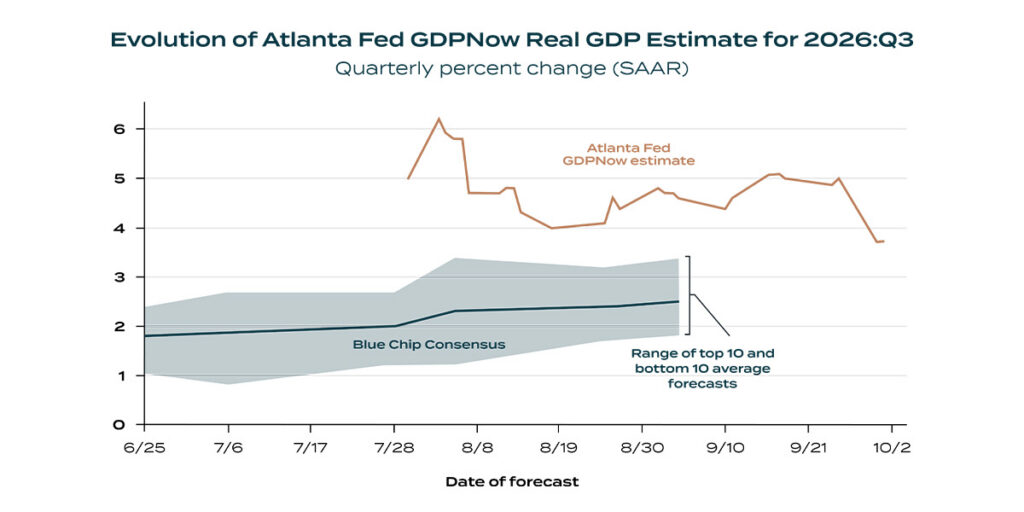
The U.S. economy continues to do better than expected. Data has consistently surprised to the upside, the Atlanta Fed’s GDPNow model was recently tracking third-quarter growth near 3.7%, and near-term recession odds remain low.
But it pays to look beneath the aggregate. Growth today rests heavily on AI-related capital investment, which is contributing a far larger share of growth than usual. Manufacturing is in its strongest expansion since May 2022. Capex-led growth is less sensitive to interest rates than consumer-led growth, which helps explain the economy’s resilience, but it rests on a narrower base.
The labor market is stable rather than strong. Hiring is low, layoffs are low, and unemployment sits near 4.2%, partly because people have left the labor force. That equilibrium is calm, but it may not prove especially sturdy if conditions change.
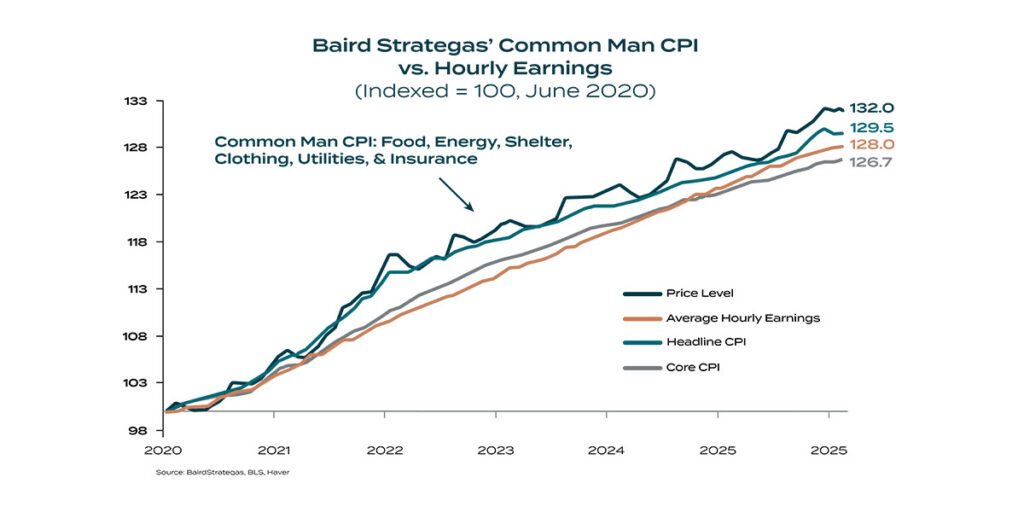
And the consumer is really two different consumers. Higher-income households are carrying aggregate spending, while middle- and lower-income spending has roughly kept pace with inflation, which is to say it has not grown in real terms. Our “Common Man CPI,” which tracks necessities such as food, energy, shelter, and insurance, is running ahead of average hourly earnings. The savings rate has fallen to about 2.7%, consumer confidence has weakened, and retailers such as Walmart have pointed to softening activity tied in part to gas prices. This is how inflation expectations can look calm while many households feel anything but.
It would be easy to tell a gloomy story from these facts. The honest observation is that the underlying business data simply is not showing broad weakness yet.
EARNINGS: THE PILLAR UNDER THE MARKET
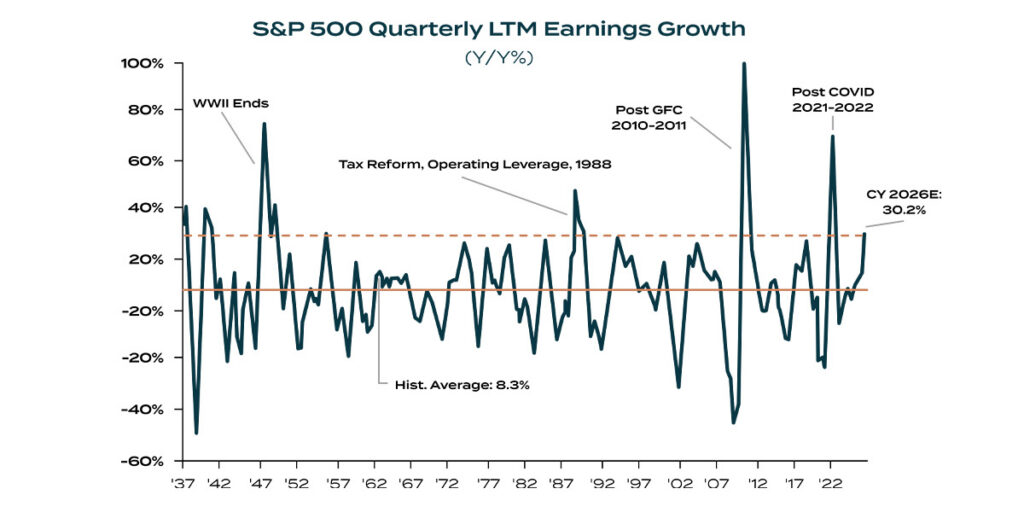
Earnings have been the great surprise of 2026 and the clearest reason equities have held up. Ordinarily, estimates drift lower as the year goes on; that pattern holds across nearly every historical period one might examine. This year, analysts have been revising higher all along. Second-quarter S&P 500 earnings grew roughly 50% year over year, more than double initial estimates, and full-year growth is tracking near 30%.
Growth of this magnitude usually appears only when the economy is climbing out of a recession. We are seeing recession-recovery growth without the recession, and we know of no clean precedent.
Importantly, the strength is broad. Sales and earnings have both outperformed on a broad basis, and revenue is much harder to engineer than earnings. Operating margins have reached about 21% for the index and are rising even on an equal-weighted basis. Growing AI adoption is beginning to show up in productivity data, which may help explain how companies are widening margins despite higher costs.
The AI question. AI capital spending of roughly $800 billion in 2026 has been a major engine for both earnings and GDP. Recent calls from industry leaders to slow frontier-model development have prompted investors to ask whether that pace is sustainable, and the conversation has moved from whether companies are spending to what return they will earn. We do not see this as a simple boom-or-bust question. Infrastructure spending is a rate-of-change story, and rates of change eventually slow. But a shift from building models to using them could moderate some infrastructure spending while spreading the benefits more widely. The first phase rewarded the builders; the next may reward the users. That possibility is promising, but it comes with a familiar caution: A good idea and a good investment are not the same thing. The difference lies in the price paid and the expectations already embedded in it.
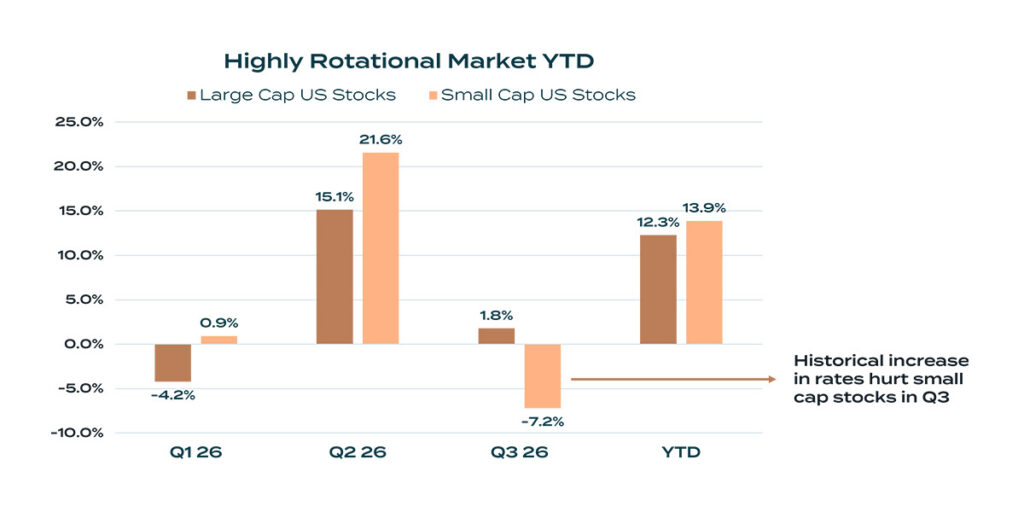
A rotational market. Leadership changed repeatedly beneath the surface this quarter, with investors at times reaching beyond the largest technology names toward cyclical sectors and smaller companies. When rates rose late in the quarter, money flowed back toward large-cap technology, whose balance sheets looked comparatively safe. We find the broadening encouraging, since a market supported by many sources of return is generally less fragile than one dependent on a few, and the reversal a useful reminder of how quickly leadership can shift when the discount rate moves.
Valuations. Equity valuations have compressed this year as earnings have outpaced prices. U.S. stocks trade in line with their three-year average on a forward P/E basis, though above longer-term averages. Valuation is not, in our view, a reason to be defensive, but it does mean the market needs earnings to keep delivering. It is worth noting that 2027 growth expectations have already eased from about 17% in early July to around 13%. If that continues, future returns may depend more on valuation than on earnings growth, a different dynamic than this year’s.
WHAT THIS MEANS FOR YOUR PORTFOLIO
Markets appear to be climbing another wall of worry, a familiar and not necessarily unhealthy pattern. History suggests equities have, on average, advanced through Fed hiking cycles, since rate increases tend to accompany the kind of growth that supports earnings. Higher for longer is not automatically bearish.
Fixed income: favoring shorter duration exposure. With no easing bias from the Fed, the possibility of further hikes, and structural pressure on long yields from deficits and Treasury supply, we do not believe investors are being adequately paid to take on long-duration risks. Meanwhile, cash and short-term bonds are earning more than they have in years. We believe in using a multi-sector global exposure to both rates and credit that is less reliant on rate movements than traditional benchmark-focused strategies.
Equities: staying invested, with an eye on breadth. Earnings remain the primary support for stocks, and that support is intact. We believe the market is in the early stages of a shift from leadership by a small group of extraordinary companies toward a broader base of earnings growth.
Addressing concentration risk now. Much of this year’s growth has come from AI infrastructure spending. We think it prudent to manage that exposure before any slowdown in the cycle, not after, by positioning portfolios to benefit from AI adoption across the broader economy.
Planning for volatility rather than reacting to it. A Fed providing less guidance, combined with an unpredictable energy market, likely means sharper swings around data releases and policy meetings.
A final word on timing. Every uncertainty in this letter is a reason someone might offer for stepping aside. The trouble is that the costs of being wrong are not symmetrical. Some of the market’s best days tend to arrive close to its worst, and missing just a handful of them can meaningfully reduce long-term results. We do not think the right response to an uncertain future is to guess at it. We think it is to be prepared for a range of outcomes.
LOOKING AHEAD
Three questions will shape the months ahead: whether energy prices ease enough to relieve pressure on inflation and long-term rates; whether September’s hike proves to be a single move or the start of a longer hiking cycle; and whether the payoff from AI investment arrives on a timeline that sustains today’s earnings expectations.
We do not know how these will resolve, and we would be wary of anyone who claims to. What we do know is that the foundation of this market, broad-based and margin-supported earnings growth, remains solid; the economy continues to surprise to the upside; and the risks we have described are ones we are actively monitoring and managing on your behalf.
As always, thank you for the trust you place in us. If you have questions about this letter, your portfolio, or how these themes affect your financial plan, please reach out to your advisory team.
The views expressed represent the opinion of Sequoia Financial Group. The views are subject to change and are not intended as a forecast or guarantee of future results. This material is for informational purposes only. It does not constitute investment advice and is not intended as an endorsement of any specific investment. Stated information is derived from proprietary and nonproprietary sources that have not been independently verified for accuracy or completeness. While Sequoia believes the information to be accurate and reliable, we do not claim or have responsibility for its completeness, accuracy, or reliability. Statements of future expectations, estimates, projections, and other forward-looking statements are based on available information and Sequoia’s view as of the time of these statements. Accordingly, such statements are inherently speculative as they are based on assumptions that may involve known and unknown risks and uncertainties. Actual results, performance or events may differ materially from those expressed or implied in such statements. Investing in equity securities involves risks, including the potential loss of principal. While equities may offer the potential for greater long-term growth than most debt securities, they generally have higher volatility. Past performance is not an indication of future results. Investment advisory services offered through Sequoia Financial Advisors, LLC, an SEC Registered Investment Advisor. Registration as an investment advisor does not imply a certain level of skill or training.









Can AI Strength Continue to Offset Deteriorating Market Breadth?