
Market Commentary
Financial Markets Still Grappling with High Oil Prices and Higher Interest Rates

by Sequoia Financial Group
by Sequoia Financial Group
The shortened Labor Day trading week brought little cheer for stock and bond investors. Coming off a long weekend that saw increased hostilities between the US and Iran, oil prices pushed higher, topping $100/barrel. Gas and diesel prices also spiked: diesel hit an all-time high of $6/gallon, while regular gas jumped to a Labor Day record of $4.15/gallon. The cost of diesel affects all products that are shipped, so higher diesel prices have an inflationary impact across the entire economy. Meanwhile, consumers spending more to fill their tank with gas have less to spend on discretionary items.
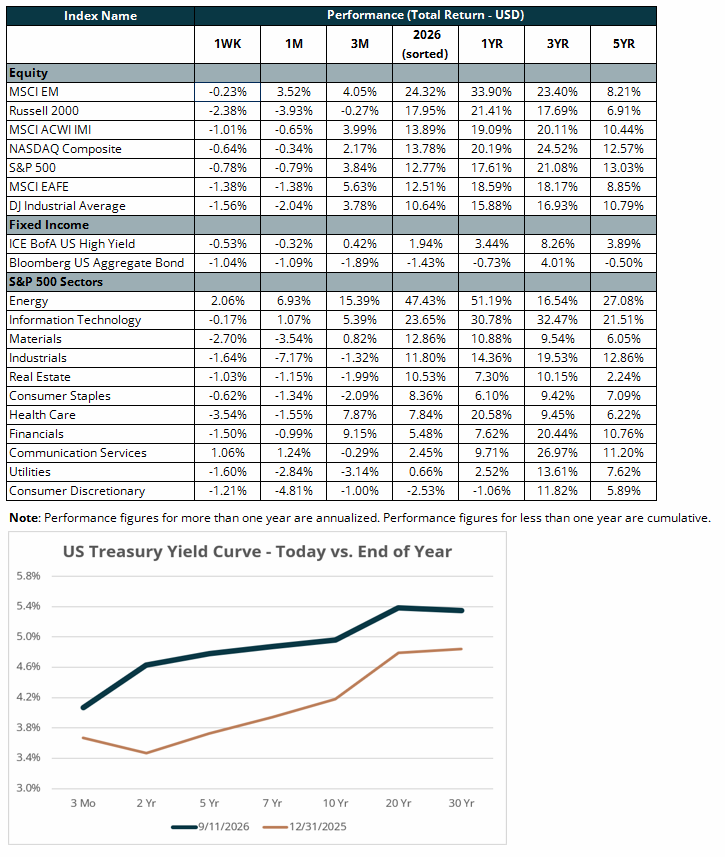
Producer and consumer price reports released last week illustrated the persistent inflation problem. Producer prices pushed 0.4 per cent higher for the month and 5.4 per cent higher for the year to date. The report was in line with expectations, but showed inflation remains far from the Federal Reserve’s two per cent target. Consumer inflation proved equally sticky, with prices also jumping 0.4 per cent for the month. The headline number matched Dow Jones estimates, but inflation excluding energy and food climbed a bit more than expected. The reports pushed the odds of the Fed raising interest rates by a quarter point at its September 16 meeting to 90 per cent. Just a month ago, the odds of a rate hike stood at less than 50 per cent. The reports also drove bond yields higher, with the 10-year Treasury yield nearly breaking though five per cent, a level not seen since 2023 and then only briefly.
The stock market staged a relief rally on Friday despite the higher rate-hike odds. Typically, higher rates are seen as a negative for stocks, but uncertainty surrounding a rate hike can be a bigger negative. The market also got a bump from Oracle, which delivered a solid earnings report. Revenue and earnings both grew 30 per cent and topped Wall Street estimates. The results provided additional support for AI and data center bulls, as Oracle’s backlog reached a record $664 billion. Oil prices also pulled back a bit from the week’s high, ending on Friday at $100.05/barrel.
Despite the Friday rally, which saw each of the major benchmarks jump roughly one per cent, stocks ended the week slightly lower. Bonds also slipped, with the Bloomberg Aggregate Bond Index now down 1.3 per cent since the first of the year. Attention now turns to the Fed, which meets on Wednesday. A 0.25 per cent rate hike looks to be on the table.
The views expressed represent the opinion of Sequoia Financial Group. The views are subject to change and are not intended as a forecast or guarantee of future results. This material is for informational purposes only. It does not constitute investment advice and is not intended as an endorsement of any specific investment. Stated information is derived from proprietary and nonproprietary sources that have not been independently verified for accuracy or completeness. While Sequoia believes the information to be accurate and reliable, we do not claim or have responsibility for its completeness, accuracy, or reliability. Statements of future expectations, estimates, projections, and other forward-looking statements are based on available information and Sequoia’s view as of the time of these statements. Accordingly, such statements are inherently speculative as they are based on assumptions that may involve known and unknown risks and uncertainties. Actual results, performance or events may differ materially from those expressed or implied in such statements. Investing in equity securities involves risks, including the potential loss of principal. While equities may offer the potential for greater long-term growth than most debt securities, they generally have higher volatility. Past performance is not an indication of future results. Investment advisory services offered through Sequoia Financial Advisors, LLC, an SEC Registered Investment Advisor. Registration as an investment advisor does not imply a certain level of skill or training.









Financial Markets Still Grappling with High Oil Prices and Higher Interest Rates