
Market Commentary
Iran Deal Never Came. Stocks Didn’t Care.

by Sequoia Financial Group
by Sequoia Financial Group
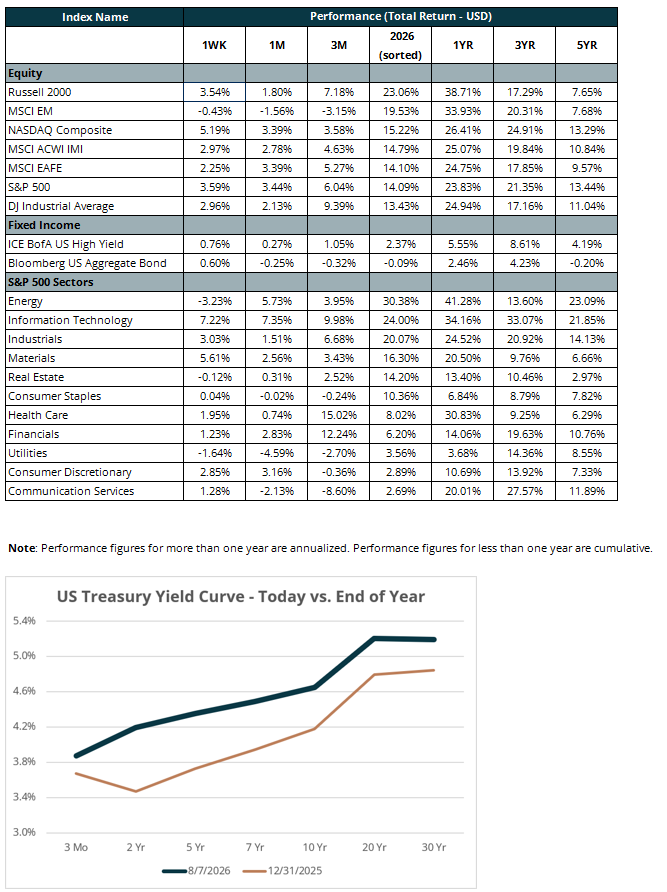
Equities opened the week higher after Treasury Secretary Scott Bessent signaled on Monday morning that a deal to reopen the Strait of Hormuz could be reached within a day or two. That fueled a two-session rally that helped carry the S&P 500 to its best week since April. But that deal never materialized. Reports throughout the week pointed instead to a more complicated Iran-Oman framework, which would bar U.S. and Israeli vessels and impose fees on shipowners. Though by Friday the arrangement looked no closer to completion, equity markets shrugged it off – all the major US indices closed at all-time highs. The S&P finished the week up 3.6 per cent and is now up 14.1 per cent year to date, the Dow Jones Industrial Average (DJIA) rose three per cent (+13.4% YTD), and the NASDAQ led with a 5.2 per cent advance (+15.2% YTD). Breadth was healthy throughout, with S&P gainers outnumbering decliners by more than two-to-one on the week.
Fixed income and gold both caught a bid as the market grew more focused on growth risk than inflation risk by week’s end. The 10-year Treasury yield fell to 4.64 per cent, while the 30-year yield eased back from its highest level since 2007. Gold jumped 7.1 per cent, its best week since January, and silver rose 9.8 per cent, its best week since February. Friday’s weak jobs report reinforced a “bad news is good news” dynamic that pushed September rate-hike odds down more than 10 percentage points to around 44 per cent.
Underneath the headline gains, the real story of the week was earnings, not geopolitics. With roughly 88 per cent of the S&P 500 having reported, blended Q2 earnings growth stands at 50.4 per cent. Even excluding outsized contributions from Alphabet (ticker: GOOGL) and Amazon (ticker: AMZN), growth still runs at 29.2 per cent, comfortably above longer-term averages. Guidance trends were just as notable, with the share of companies raising forward guidance running at its highest level since 2021. Not every beat was rewarded, however. Advanced Micro Devices (ticker: AMD), Sandisk (ticker: SNDK), and Western Digital (ticker: WDC) all fell on high expectations despite solid results. SpaceX (ticker: SPCX) dropped on capex concerns after a strong debut quarter. Alphabet lagged the broader tech rally after reports its chief scientist and several senior researchers plan to depart for a rival AI venture.
Friday’s July jobs report was the week’s most consequential data point: nonfarm payrolls fell by 23,000, versus expectations for an 80,000 gain. Payrolls from May and June were revised down by a combined 103,000. The unemployment rate ticked down to 4.1 per cent, though only because labor-force participation fell to its lowest level in over five years. That data sets up next Wednesday’s July CPI report, as the key test for whether markets can extend their gains into a fourth straight week.









Tech Stocks Carry NASDAQ to Record High